
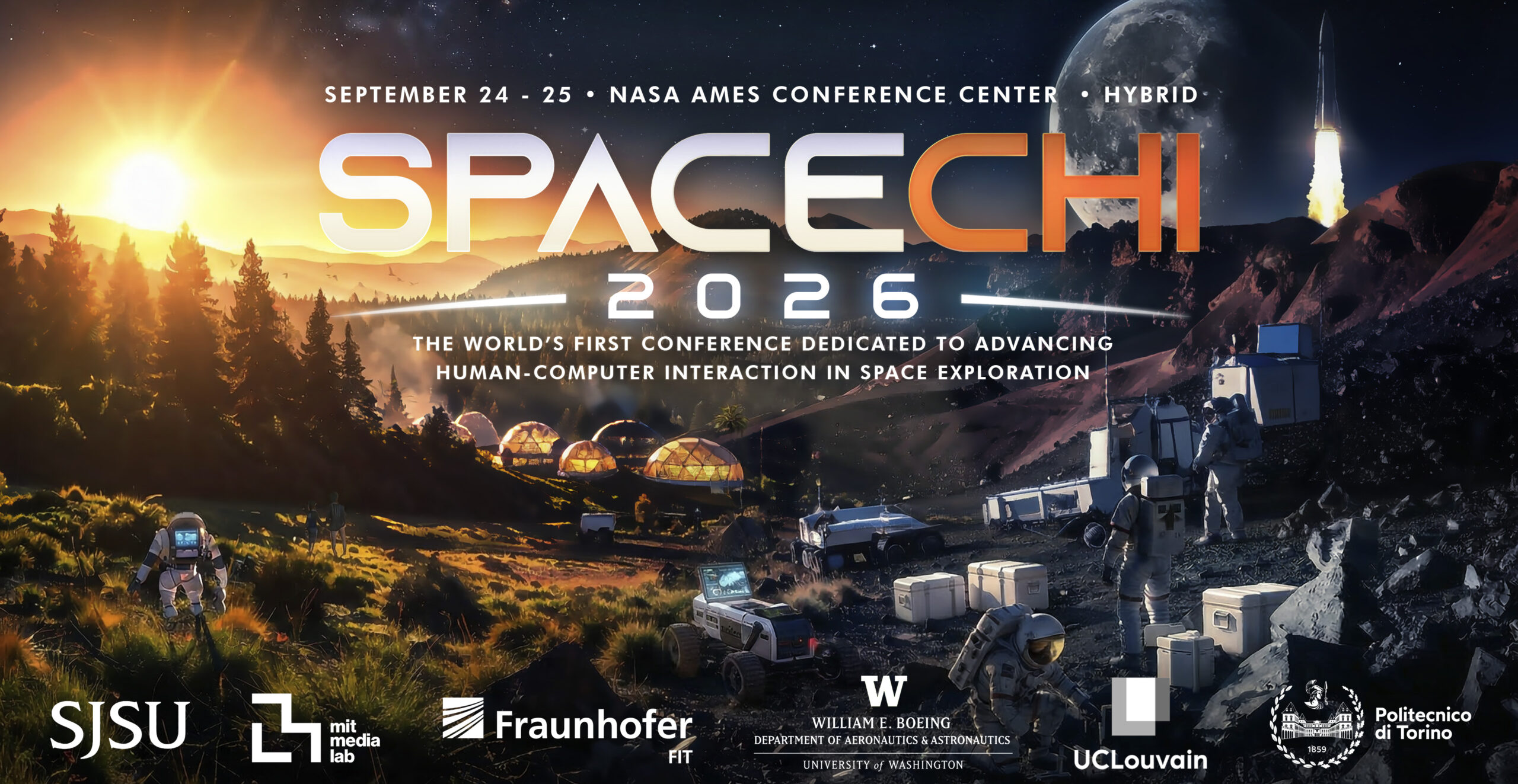
SpaceCHI 2026 at the NASA Ames Research Center,
Both on-site and remote participants are welcome
September 24-25, 2026
Day(s)
:
Hour(s)
:
Minute(s)
:
Second(s)
Space exploration is at the dawn of a new era. Major reductions in launch costs and the rise of the private space industry are rapidly democratizing access to space. Once the exclusive domain of a few large government agencies, space systems and services are now poised to become increasingly intertwined with everyday life. This transformation is giving rise to entirely new economic sectors and opening the door to novel uncharted research directions.
Human-Computer Interaction (HCI) has historically played a vital role in helping to scale emerging technologies and maximize their societal benefits – from the laser printer and the personal computer to groupware and AI. HCI’s tools and methodologies, honed over decades of refinement, are uniquely positioned to help drive the current space transformation.
SpaceCHI seeks to catalyze this potential by providing an interdisciplinary platform for researchers and practitioners worldwide. Hosted at NASA Ames, one of the most revered bastions of space research, and located in Silicon Valley, the beating heart of technological innovation, this year’s edition of the conference promises an unforgettable experience featuring insights from uniquely qualified experts. SpaceCHI 2026 adopts a hybrid format, welcoming both on-site and remote participants to present and engage. It is our pleasure inviting you to join us in shaping the future of HCI and space exploration!
Important Dates:
-
17 July (23:59, AoE) – Submission deadline
-
27 July – Notifications, registration opens
-
18 September – Camera ready
-
23 September – Registration closes
-
24-25 September – Conference
Submission Guidelines
SpaceCHI adopts a broad interdisciplinary scope, welcoming submissions on a wide range of subjects related to HCI in space exploration. Examples of relevant topics include:
- Human-AI Interaction for Space Exploration
- On-body/Wearable Technology for Space Health
- Human-Robot Interaction for Deep Space Mission
- Interfaces for Human Expression in Space
- Trust within Autonomous and Intelligent Systems
- Cognitive load and Human Performance Issues
- Computer-supported Cooperative Work
- Space Fabrication
- Augmented Reality/Mixed Reality
- Space Food & Humanizing Space
- Built Environment & Space Architecture
- Smart Vehicles & Navigation
- Digital Fabrication for Space Missions
At least one author of each accepted submission must register for and attend the conference to present their work. For those unable to attend the conference on-site, we offer a remote presentation option via Microsoft Teams. This year, we accept two types of submissions – papers and posters. All submissions are made through Microsoft CMT via this link.
Papers
Paper submissions should follow the standard Springer proceedings template, available in both LaTeX and Word formats here. We welcome a variety of paper submissions, including full research papers and position papers. While there is no strict page limit, the length of each submission should correspond to the scope and significance of its contributions. In practice, SpaceCHI papers typically range between 5 and 15 pages, excluding references. Examples of papers accepted at previous editions of SpaceCHI can be found here.
By submitting a paper, authors confirm that the work is not currently under review at another venue and will not be submitted elsewhere prior to notification from SpaceCHI.
Papers will be selected through a single round of double-blind peer review. All submitted papers must therefore be anonymized. Submissions will be evaluated based on:
- Relevance: Alignment with the theme of HCI in the space domain.
- Impact: Potential to stimulate meaningful community discussion.
- Originality: Novel contributions to the field.
Authors of accepted papers will be invited to submit a camera-ready manuscript in accordance with Springer’s formatting requirements. Each accepted paper will be assigned a DOI and published in a dedicated SpaceCHI proceedings volume by Springer Nature.
Posters
Researchers and practitioners interested in presenting a poster at SpaceCHI are invited to submit a one-page abstract pitching their proposed poster. No specific formatting is required – the abstract simply needs to convey the topic and relevance of the work clearly enough for the steering committee to assess its fit with the conference themes.
Authors whose abstracts are selected will be contacted and invited to prepare a poster for display at the conference. We aim to notify all applicants of the outcome by July 27th.
During the conference, each poster presenter will be invited to give a one-minute lightning presentation of their work. Posters will subsequently be on display on large 65” screens with 4K (3840 × 2160 pixels) resolution in landscape (16:9) orientation, accessible to all participants during lunch and coffee breaks.
Registration
The conference registration will open as soon as authors of accepted papers have been notified (July 27). A link to the registration portal will be posted on this website. Upon completing the registration, you will receive your conference ticket via email.
As a nonprofit conference, SpaceCHI aims to keep costs as low as possible for its participants. Nevertheless, charging a registration fee is still necessary to cover essential expenses such as open access publishing, catering and logistics. This year, we are introducing a three-tiered pricing structure. The registration fees are set at 325 USD for regular on-site attendees, 250 USD for student attendees, and 175 USD for authors attending remotely. The registration will open shortly.
Due to the finite capacity of the conference venue at NASA Ames, we prioritize attendees who are presenting papers. However, depending on final registrations, a small number of additional on-site spots may become available. These will be allocated on a first-come, first-served basis, with final availability confirmed after the submission period closes. If you are interested in attending in person without presenting, please reach out to us, and we will notify you as soon as we have more details.
Please be advised that all non-US nationals are required to undergo a security screening and approval process to gain access to NASA premises. This process can take up to one month to complete. We are currently working with NASA to clarify these requirements and are doing our best to minimize potential hurdles for our attendees.
Nationals from designated countries may experience longer processing times for their security clearance. Currently, nationals from China (including Hong Kong), Cuba, Iran, North Korea, and Syria are generally not granted access to the conference site, unless they are US Citizens or Permanent Residents (Green Card Holders). If you are a national of a designated country and are planning to attend the conference, please contact the SpaceCHI chairs immediately so we can assist you.
Contact
For questions regarding submissions and other conference matters, please contact co-chairs Tommy Nilsson or Valentina Sumini. We normally respond to enquiries within hours. If you have not heard back from us, please check your spam folder.
We are actively seeking sponsors to support SpaceCHI. We are also in talks with ACM and SIGCHI to establish SpaceCHI as an officially affiliated conference. If you are willing and able to support us with this, we want to hear from you!
SpaceCHI ’26 Conference Program
Day 1: Thursday, September 24
| Time | Event |
|---|---|
| 8:00 AM | Reception |
| 8:30 AM | Welcome & Introduction |
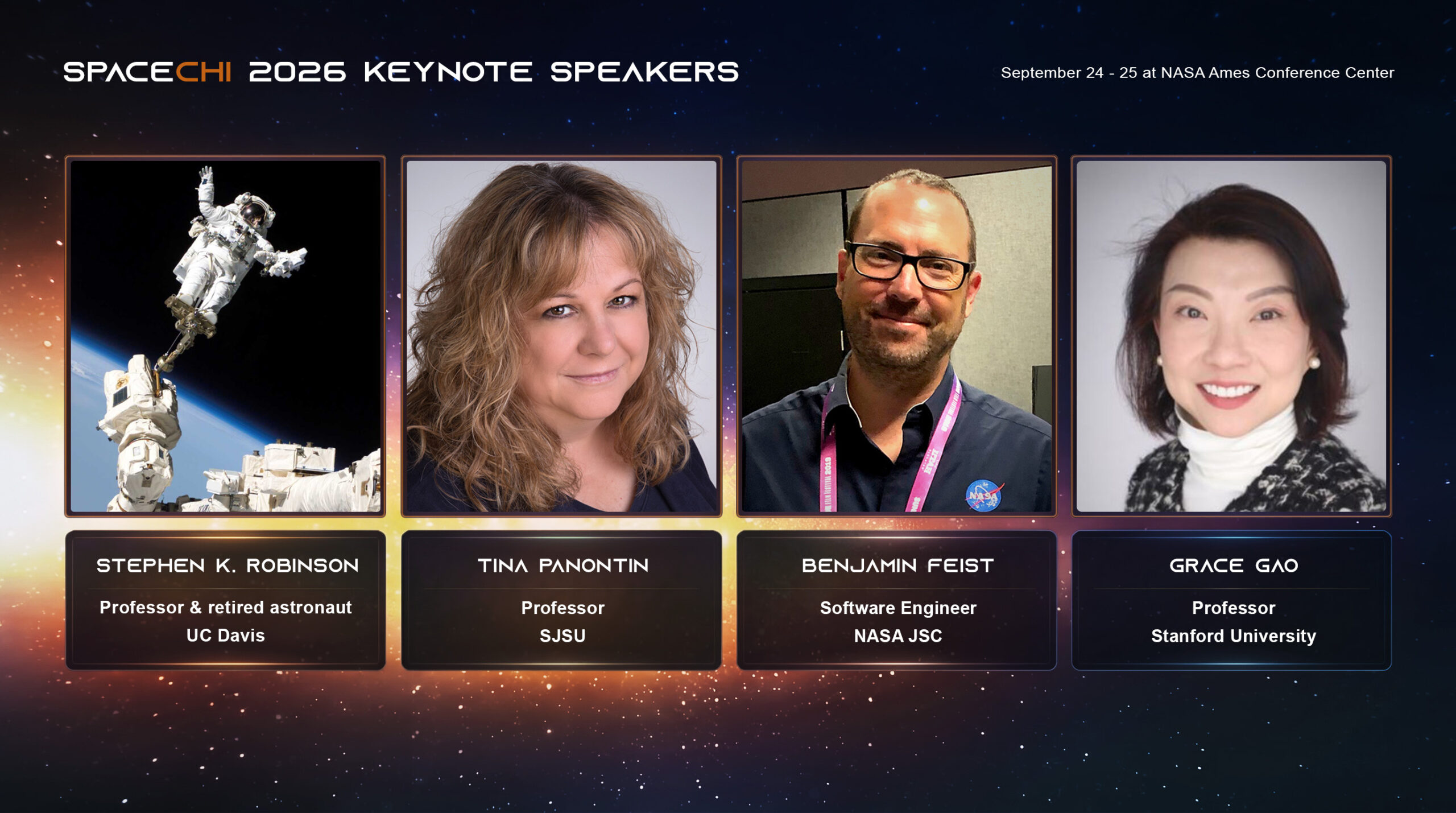
| 9:00 AM | Keynote: Steve Robinson (Title TBA) |
| 9:50 AM | Lightning Poster Presentations |
| 10:00 AM | Coffee Break |
| 10:15 AM | Paper Session 1: Wearable Interfaces for Astronaut Support |
| 11:35 AM | Keynote: Tina Panontin (Title TBA) |
| 12:15 PM | Lunch |
| 1:00 PM | Paper Session 2: Crew Autonomy under Communication Delay |
| 2:20 PM | Keynote: Grace Gao – Autonomous navigation on the Moon: rovers, drones and humanoids |
| 3:00 PM | Coffee Break |
| 3:15 PM | Paper Session 3: Human Wellbeing & Habitat Design in Extreme Environments |
| 4:30 PM | Networking Workshop with Sana Sharma (Aurelia Institute) |
| 5:00 PM+ | Evening Social at the Ames Space Bar & Optional Dinner |
Day 2: Friday, September 25
| Time | Event |
|---|---|
| 8:00 AM | Paper Session 4: XR Interfaces for Crew Training and Operation |
| 9:50 AM | Lightning Poster Presentations |
| 10:00 AM | Coffee Break |
| 10:15 AM | Paper Session 5: Human-AI Interaction |
| 11:50 AM | Keynote: Ben Feist – From Restoring Apollo to Artemis EVA Operations: One Software Engineer’s Journey |
| 12:30 PM | Lunch |
| 1:15 PM | Paper Session 6: Robotics & Teleoperation |
| 3:00 PM | Coffee Break |
| 3:15 PM | Paper Session 7: HCI for Space: Agenda and Future Directions |
| 4:40 PM | Closing Notes – Future of SpaceCHI |
| 5:00 PM | Conference Adjourns |
Session Details
Paper Session 1: Wearable Interfaces for Astronaut Support
(September 24, 10:15 AM – 11:35 AM)
- Blinking Under Pressure: Blink Input Filtering in High-Stress Situations
Konstantinos Roumpas (University of Patras)* [Remote], Dimosthenis Minas (University of Patras), Michalis Xenos (University of Patras) - Agency or Attribution? Touch and Sensory Countermeasures in Long-Duration Spaceflight
Elena Atanasova (University College London)* [Remote] - Wearable Haptic Displays for Lunar Surface Operations
Yarik Möller (ESA)*, Joshua Woolley (ESA), Aidan Cowley (ESA) - Preference and Performance of Wearable Gestures: Earth to Mars Analog
Nuwan Attygalle (Université catholique de Louvain)*, Joanna Galloway (Université catholique de Louvain), Jean Vanderdonckt (Université catholique de Louvain) - XR and Simulation for Astronauts, Robots and Spacecrafts
Felix Horn (PaleBlue)* [Remote]
Paper Session 2: Crew Autonomy under Communication Delay
(September 24, 1:00 PM – 2:20 PM)
- Off-Topic Chatter as an Unobtrusive Assessment of Workload
Katherine Homer (NASA)*, Jessica Marquez (NASA) - Sensemaking Without Mission Control: Onboard Assistant for Fault Diagnosis
Gokul Nathan (Univ. of Washington)*, Kavimitiran Pasupathi (Univ. of Washington), Yile Shen (Univ. of Washington), Maxwell Stafford (Univ. of Washington), Kevin Shao (Univ. of Washington), Alexander Mamishev (Univ. of Washington), Sep Makhsous (Univ. of Washington) - Designing for Mars: Human-Centered AI and Crew-Autonomous Mission Planning
Shivam Shukla (UC Santa Cruz)*, Shweta K. Sisodiya (UC Santa Cruz), Jimin Zheng (San Jose State Univ. Research Foundation), Katherine H. Jiang (NASA Ames Research Center) - Designing for Crew Anomaly Response in Future Deep-Space Missions
Carmen Roberts (San Jose State Univ. Research Foundation)*, Chance Castaneda (San Jose State Univ. Research Foundation), Joe Medwid (NASA), John Karasinski (NASA), Shu-Chieh Wu (San Jose State Univ. Research Foundation), Tina Panontin (San Jose State Univ. Research Foundation), Alonso Vera (NASA) - CAIS: Crew Anomaly Investigation System Under Communication Delay
Memie Osuga (Carnegie Mellon University)*
Paper Session 3: Human Wellbeing & Habitat Design in Extreme Environments
(September 24, 3:15 PM – 4:30 PM)
- Understanding Psychosocial Dynamics in Long-Duration Space Missions
Yasin Erdal (University of Portsmouth)* - The User Experience of Analog Astronauts
Arnaud Wasseige (MARS-UClouvain Space Mission), Hippolyte Hilgers (UCLouvain), Romain Maddox (MARS-UClouvain Space Mission), Julie Manon (Cliniques Universitaires Saint-Luc), Marina Vanderdonckt (Université de Namur), Bruno Dumas (Université de Namur), Radu-Daniel Vatavu (Stefan cel Mare Univ. of Suceava), Nuwan Attygalle (UCLouvain)*, Jean Vanderdonckt (UCLouvain), Vladimir Pletser (SpaceLand Italia) - Archaeological Data and Analysis for Better Space Habitat Design
Justin Walsh (Chapman University)* - EYEDEN: Eye-inspired Ecosystem for Deep-space Exploration and Nutrition
Valentina Sumini (MIT)*, Mustafa Erkus (Politecnico di Milano), Marta Rossi (Politecnico di Torino), Franco Malerba (Space V), Patrizia Bagnerini (Space V), Vivek Jadhav (Space V), Bianca Simonassi (Space V), Dario Pezzella (Space V), Mauro Gaggero (CNR), Stefano Polato (Cucina Verticale), Giacomo Luccisano (Politecnico di Torino), Paolo Maggiore (Politecnico di Torino), Joseph Paradiso (MIT) - SPACE4SPACE: Habitat Spatial Configuration and Team Health
Chenxi Wang (Univ. of Cambridge), Simon Ladouce (Univ. of Cambridge), Michal Gath-Morad (Univ. of Cambridge)*
Paper Session 4: XR Interfaces for Crew Training and Operation
(September 25, 8:00 AM – 9:50 AM)
- Space-HUD: XR Instruction Placement on Gloved Space Maintenance Tasks
Jordan Aiko Deja (De La Salle Univ.)*, Mikkel Dominic Gamboa (De La Salle Univ.), Rendell Christian Ngo (De La Salle Univ.), Nuwan T Attygalle (UC Louvain), Radu-Daniel Vatavu (Stefan cel Mare Univ. of Suceava), Jean Vanderdonckt (UCLouvain)
- Lead the Way: Robot-Mediated Pull-Force Haptics in Redirected Walking
Suibi Che-Chuan Weng (CU Boulder ATLAS Institute)* [Remote], David Hunter (CU Boulder ATLAS Institute), Pritalee Kadam (CU Boulder ATLAS Institute), Amy Banić (Univ. of Wyoming), Ellen Yi-Luen Do (CU Boulder ATLAS Institute), Daniel Leithinger (CU Boulder ATLAS Institute)
- Training Safer Spacewalks
Anastasia Prosina (Stellar Amenities), Scott Summit (Ethereal Matter)* - LunarLens: AR Head-Up Display for Lunar South Pole EVA
Lowie Vanhee (KU Leuven)*, Jihae Han (KU Leuven), Tommy Nilsson (Fraunhofer FIT), Adalberto Simeone (KU Leuven) - Real-Time Lunar Terrain Deformation for Interactive Training
David Reiter (German Aerospace Center – DLR)* - Embedded Learning with AI-augmented XR Telepresence of Astronauts and Trainers
Fridolin Wild (The Open Univ.)*, Mikhail Fominykh (NTNU), Endrit Kromidha (Univ. of Birmingham), Stephan Pascall (WEKIT ECS Ltd), Carlo Vizzi (ALTEC Space) - UX Design Guidelines from the XR Lab
Pinar Dogru (TU Darmstadt Space Technology e.V.)*, Florian Saling (DLR/ESA), Pia Schroeter (ESA), Sonja Brungs (DLR)
Paper Session 5: Human-AI Interaction
(September 25, 10:15 AM – 11:50 AM)
- Ungoverned at Layer One: Orbital Data Gap Undermining Human-Centred AI
Bruce Nicayenzi (MIT)* - When Explanation Metrics Disagree in Planetary AI
Kacy Hatfield (Arizona State Univ.)*, Lindsay Sanneman (Arizona State Univ.) - Hybrid CNN-GBT Deviation Mapping for Human-Centered Space Inspection
Md Manjurul Ahsan (Univ. of Oklahoma)*, Shivakumar Raman (Univ. of Oklahoma), Yingtao Liu (Univ. of Oklahoma), Zahed Siddique (Univ. of Oklahoma) - Beyond Automation: Agentic AI as a Virtual Crew Member
Martin Dautriche (DLR)*, Daniel Burandt (DLR), Sabine Theis (DLR) - “Sweet Spot” in Human-Machine Teamwork
Kazuhiko Momose (Amentum)* [Remote], Waseem Samkari (Florida Institute of Technology), Ali Almashaykhi (Florida Institute of Technology), Thomas Eskridge (Florida Institute of Technology) - When Crewmates Become More Trusted Than Information Displays
Cara Spencer (CU Boulder)*, Aaron Allred (CU Boulder), Erin Richardson (CU Boulder), Allison Hayman (CU Boulder), Leanne Hirshfield (CU Boulder)
Paper Session 6: Robotics & Teleoperation
(September 25, 1:15 PM – 3:00 PM)
- Supporting Mission Control Operations Through 3D Visualisation
Joshua Woolley (ESA)*, Yarik Möller (ESA), Noora Archer (ESA/Telespazio), Romain Charles (ESA), Aidan Cowley (ESA) - Human Performance in Intercontinental Teleoperation
Elena Lopez-Contreras (ISAE-SUPAERO)* [Remote], Gaurav Dhiman (Indian Institute of Science), Raphaëlle N. Roy (ISAE-SUPAERO ONERA), Pradipta Biswas (Indian Institute of Science), Vsevolod Peysakhovich (ISAE-SUPAERO ONERA) - Asking Questions of the Moon: Conversational Spatial Analytics for Lunar Data in AR
Matti Gruener (MIT)*, Cecilia Marsicovetere Fanjul (MIT) - Toward VR Teleoperation of Lunar Rovers
Alaeddin Nassani (Univ. of Aizu), Yoshiko Ogawa (Univ. of Aizu), Ryuhei Yamada (Univ. of Aizu), Julián Villegas (Univ. of Aizu), Makiko Ohtake (Okayama Univ.), Huidong Bai (Univ. of Auckland), Mark Billinghurst (Univ. of Auckland)* [Remote] - UNITE: A Modular Testbed for Reproducible Delayed Space Teleoperation
Dries Cardinaels (UHasselt)*, Kris Luyten (UHasselt), Raf Ramakers (UHasselt), Thomas Pietrzak (Univ. Lille, Inria, CNRS) - A Neoteny Index for Embodied Robots and Virtual/AR Agents
Francisco Martinez-Ruiz (Univ. of Zacatecas)* [Remote], Jean Vanderdonckt (UCLouvain), Jorge Flores Troncoso (Univ. of Zacatecas)
Paper Session 7: HCI for Space: Agenda and Future Directions
(September 25, 3:15 PM – 4:40 PM)
- A Brief Review of Human-Machine Interaction (HMI) in Space
Ajit Krishnan (Indian Institute of Science), Pradipta Biswas (Indian Institute of Science)* - To Mars, Please: Are Interaction Design Frameworks Ready to Leave Earth?
Radu-Daniel Vatavu (Stefan cel Mare Univ. of Suceava)* [Remote], Jean Vanderdonckt (UCLouvain) - Virtual Production as a Programmable Fidelity Substrate for Analog Missions
Dan Novy (Univ. of Nebraska–Lincoln)* - MIDP: Mars Interaction Design Principles from a Systematic Literature Review
Marina Vanderdonckt (Univ. of Namur)*, Bruno Dumas (Univ. of Namur) - Superman Suit: A Photovoltaic Neuromuscular Safety Net for Off-World Habitats
Nantita Damrongpanawan (Bangkok Univ.)*, Taechasith Kangkhuntod (Univ. of the Thai Chamber of Commerce)
Day 1 Poster Presentations
(September 24, From 9:50 AM)
- Training for Space: Understanding Optimal Stress Levels for Skill Transfer in Adaptive VR
Violeta Koleva (Univ. of Bath)*, Eamonn O’Neill (Univ. of Bath), Christof Lutteroth (Univ. of Bath), Crescent Jicol (Univ. of Bath) - Designing for the Engineers Behind the Mission: A Human-Centered Approach to Requirements Traceability at NASA Jet Propulsion Laboratory
Joyce Croft (NASA JPL)*, Paul Lumsdaine (NASA JPL) - Allocating Human Attention Under Uncertainty: A Transferable Framework from Exoplanet Discovery
Sofia Platymesi (Univ. of Oxford)* [Remote] - Visual Prosody: A Legibility-Preserving Approach for Emotionally Expressive Text in Interplanetary Communication
Shichen Zhang (Hasselt Univ.), Ann Bessemans (Hasselt Univ.)* - A Presence With No Face: An Ambient Companion for Meaning and Morale on the Mars Transit
Mohd Saim Nasim Lari (Siemens)*, Pranav Kumar (Siemens) - Design and Development of Space-HUD for Analog and Space Missions
Jordan Aiko Deja (De La Salle Univ.)*, Rendell Christian Ngo (De La Salle Univ.), Mikkel Dominic Gamboa (De La Salle Univ.), Nuwan T Attygalle (UCLouvain), Jean Vanderdonckt (UCLouvain), Radu-Daniel Vatavu (Stefan cel Mare Univ. of Suceava) - Exploring the Impact of Physical Coherence in XR-Based Training for Brachially-Constrained, Body-Centric Locomotion: An Analogue Study for Spacewalks
James Tennant (Independent)* - Addressing Human Intervention Under Communication Latency in Exploration Missions Beyond Earth
Dat Dang (San Jose State Univ.)*, Ali Guarneros-Luna (San Jose State Univ.)
Day 2 Poster Presentations
(September 25, From 9:50 AM)
- Characterizing Radiation Shielding Materials for Resilient Space Systems
Pavlova Orozco Corona (San Jose State Univ.)*, Harman Singh (San Jose State Univ.), Quanna Trieu (San Jose State Univ.), Francisco Veragas Vasquez (San Jose State Univ.), Ali Guarneros-Luna (San Jose State Univ.) - SYNOVA: A Mixed Reality Framework for Human-Robot Mission Orchestration in Space
Jinu S U (Siemens), Mohd Saim Nasim Lari (Siemens)*, Pranav Kumar (Siemens) - The Effect of Wearing a Prototype Spacesuit: An Interdisciplinary Human Performance Optimisation Approach
Marcus Peach (Univ. of Chichester)* [Remote], Kieran McAllen (King’s College London), Josep Ivars Martinez (King’s College London), Kaia Pilbeam (Univ. of Chichester), Christopher Vine (Univ. of Chichester), Jarle Steinberg (Nava Space), Oliver Runswick (King’s College London) - SONIKOSMOS: SOL-ω — A Real-Time Planetary Instrument, Compositional System, and Notation Framework as a Human Interface for NASA JPL Ephemeris Data
Javier Roqueni Healy (Berklee College of Music)* - Development of a Multi-Fidelity MATLAB-Unreal Engine Software-in-the-Loop Architecture for Horizon-Based Lunar EVA Navigation Displays
Sabeane Escobedo Palacios (MIT Department of Aeronautics and Astronautics)* - The First Module Is a Social Decision: How Habitat Geometry Shapes Access and Urban Form in Off-World Settlements
Maya Soylu (Bilkent Univ.)* - Design Considerations for Tangible Human–Swarm Interaction in Orbital Habitat Inspection
Eden Elfassy (ESILV)*, Thomas Juldo (De Vinci Higher Education / Sorbonne / CNRS), Mariana Tamashiro (IFT / De Vinci Higher Education) - Designing a Portable Stowage Board for Interrupted Work in Microgravity
Oluwalayomi Akinrinade (Univ. of Washington)*
The NASA Ames Conference Center (NACC)
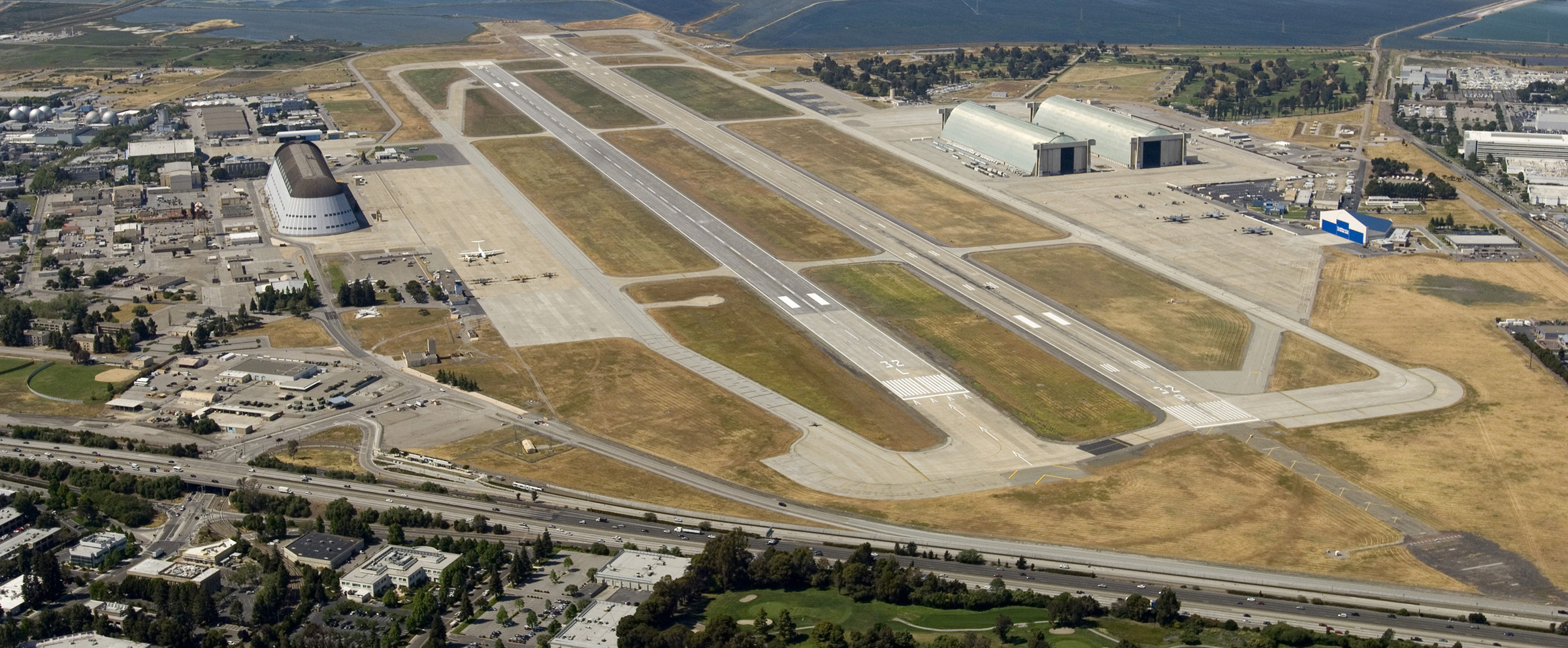
The 2026 edition of SpaceCHI will be hosted at the NASA Ames Research Center (also known as the NASA Silicon Valley Event Center – SVEC), located in the sunny Mountain View, California. Situated next to the historic Moffett Federal Airfield and the former Naval Air Station, the venue features flexible meeting spaces, dedicated exhibit areas, a historic auditorium, and a spacious outdoor patio. As one of NASA’s ten primary field centers, Ames has been at the forefront of world-class space research since 1939, leading the way in aeronautics, science, and exploration technology.
Steering Committee
- Tommy Nilsson, Fraunhofer FIT
Leonie Bensch, MIT Media Lab - Jessica Marquez, NASA Ames
- Jean Vanderdonckt, UCLouvain
- Valentina Sumini, MIT Media Lab
Pat Pataranutaporn, MIT Media Lab
Martin Nisser, University of Washington - Leif Oppermann, Fraunhofer FIT
- Sheryl Ehrman, SJSU
- Periklis Papadopoulos, SJSU
- Nikos Mourtos, SJSU
- Nicole Okamoto, SJSU
- André Füzfa, University of Namur
- Bruno Dumas, University of Namur
- Adalberto Simeone, KU Leuven
- Russel Andrews, World Federation of Neurosurgical Societies, Stanford University (invited lecturer)
- Oliver Bensch, German Aerospace Center (DLR)
- Scott Davidoff, Space Science Institute, Carnegie Mellon University
Joseph Paradiso, MIT Media Lab - Albrecht Schmidt, LMU Munich
- Aidan Cowley, ESA EAC
- Lionel Ferra, ESA EAC
Dava Newman, MIT Media Lab
Cody Paige, MIT Media Lab
Marianna Obrist, University College London
Conrad Zeidler, German Aerospace Center (DLR)
Ariel Ekblaw, MIT Media Lab
Pattie Maes, MIT Media Lab
Melodie Yashar, San Jose State Research Foundation, NASA Ames
Alonso H. Vera, NASA Ames
Conference chairs
Jean Vanderdonckt (UCLouvain), Valentina Sumini (MIT Media Lab), Leonie Bensch (MIT Media Lab), Tommy Nilsson (Fraunhofer FIT)
Program chairs
Jessica Marquez (NASA Ames), Martin Nisser (University of Washington)
Registration and Finance chair
Periklis Papadopoulos (SJSU)
Reviewers
TBA
*SpaceCHI is a non-profit initiative and does not receive direct financial support from any external sponsors. All listed affiliations and logos represent co-organizing institutions that provide in-kind support and logistical cooperation for this event.
The Microsoft CMT service was used for managing the peer-reviewing process for this conference. This service was provided for free by Microsoft and they bore all expenses, including costs for Azure cloud services as well as for software development and support.